9 in 10 chip and fry samples test positive for a possible carcinogen: what to look for after the Consumer Council's 77-snack test
Eat less, pick lighter-coloured, swap in prawn crackers or veggie chips — do all three and you can stock your cupboard with confidence.
What happened
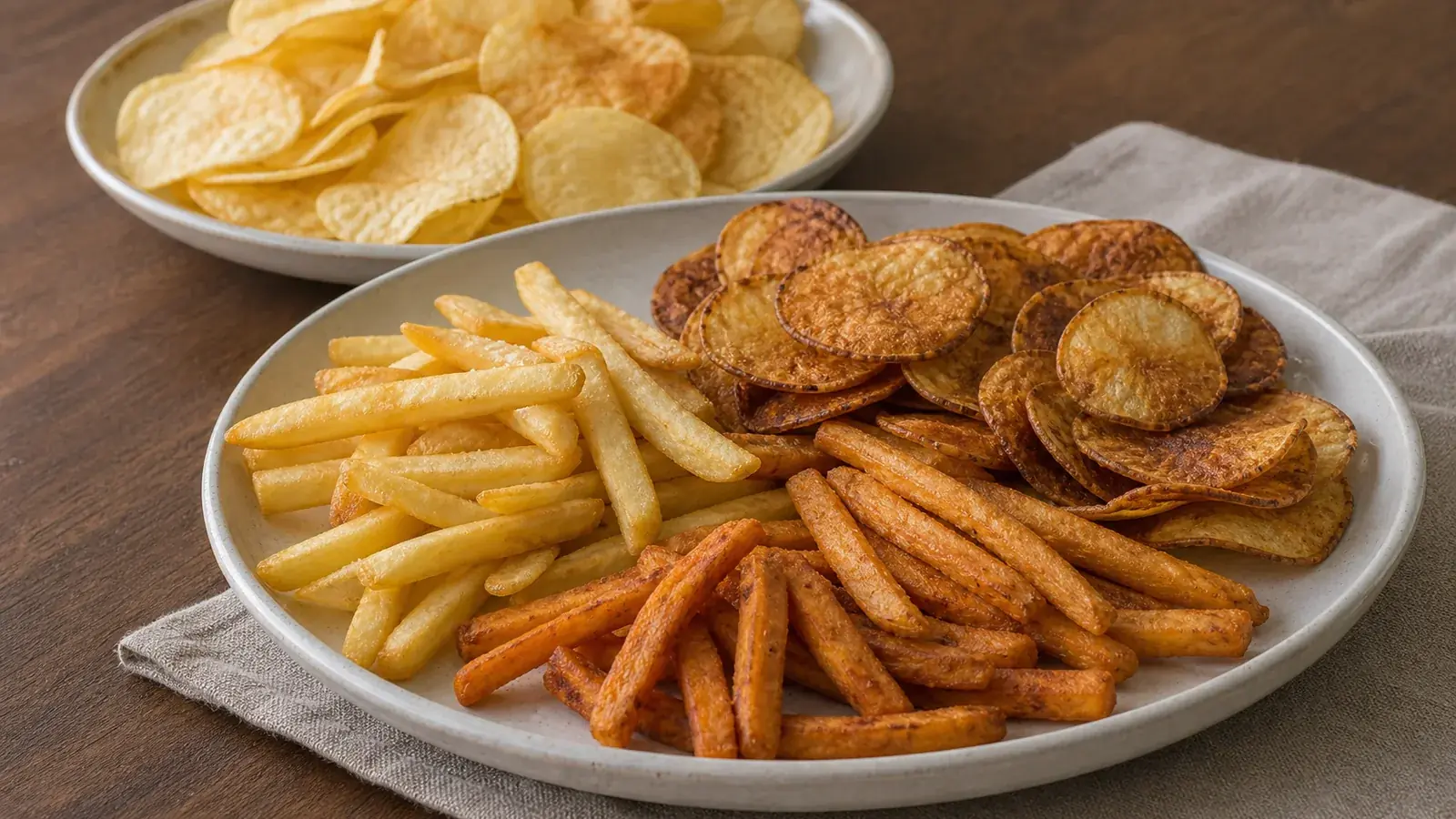
The Consumer Council purchased 77 crunchy snack samples — including 67 pre-packaged products (chips, fries, prawn crackers, corn chips, veggie chips, quinoa crisps, sweet potato chips) and 10 non-pre-packaged ready-to-eat items from restaurants and fast-food outlets (fries, waffle fries, hash browns) — and tested them for acrylamide, fat, and sodium content.
Which parents should pay attention
- Children weigh less, so the same portion carries proportionally higher risk than for adults
- Households where chips or fries appear 3 or more times a week
- Families who regularly buy fries or waffle fries from fast-food outlets for their kids
- Families who buy large bags and tend to finish them in one go
What the Consumer Council's report actually says
12 samples that exceeded EU benchmarks
Test values reflect August 2020 and are not a current commitment from the brands.
← Scroll left/right to see full table →
| Source / Brand | Sample | Acrylamide level | Times over benchmark |
|---|---|---|---|
| Five Guys | Fries | 964 μg/kg | 1.9× |
| IKEA | Crispy Waffle Fries | 639 μg/kg | 1.3× |
| The Spaghetti House | Star-shaped Hash Browns | 701 μg/kg | 1.4× |
← Scroll left/right to see full table →
| Brand | Sample | Origin | Acrylamide level |
|---|---|---|---|
| Topvalu | Best Price Potato Chips Salt Flavor | Japan | 2,614 μg/kg (3.5× benchmark) |
| Wise | Cottage Fries Spicy Flavour Chips | Malaysia | 1,726 μg/kg |
| Nissin Koikeya | Karamucho Super Spicy Devil Chips | China | 1,653 μg/kg |
| Luke's | Organic White Truffle & Sea Salt | USA | 1,351 μg/kg |
| Tohato | Spicy Potato Rings Garlic Onion Chicken | Japan | 891 μg/kg |
| Orion | O!Karto Chili Chili flavor | South Korea | 864 μg/kg |
| M&S | Sweet Chilli Hand Cooked Crisps | UK | 829 μg/kg |
| Mackie's of Scotland | Haggis & Cracked Black Pepper | UK | above 750 |
| Meadows | Tom Yum Flavour Chips | Malaysia | above 750 |
7 samples with no detectable acrylamide
← Scroll left/right to see full table →
| Brand | Sample | Acrylamide | Sodium (per 100 g) |
|---|---|---|---|
| Kou Fu Bu Qian | Natural Vegetable Chips (Taiwan) | ✓ Not detected | ~130 mg (low) |
| Bourbon | Petit Ebi Crackers | ✓ Not detected | ~1,208 mg (high) |
| Ming Fai | Indonesian Prawn Crackers Original | ✓ Not detected | ~910 mg (high) |
| Tai Way | Lobster Flavour Prawn Crackers | ✓ Not detected | ~729 mg (high) |
| Papatonk | Original Indonesian | ✓ Not detected | ~991 mg (high) |
| Sau Chau | Spicy BBQ Prawn Crackers | ✓ Not detected | ~830 mg (high) |
| GS Retail | YOUUS Shrimp Chips | ✓ Not detected | ~850 mg (high) |
What you can do today
Check whether this affects your household
- Look at the chip bags in your cupboard — dark brown or extra-crispy chips generally have higher acrylamide levels
- Think about how often your children eat crunchy snacks each week: more than 3 times is worth adjusting
Things you can do right now
- Switch from big bags to small bags, and pre-portion snacks for the kids
- If you make fries at home, cut thicker pieces and don't fry them dark brown — golden yellow is enough
- Use an oven instead of deep-frying; keeping the temperature below 180°C reduces acrylamide formation
How to choose next time you shop
- Prawn crackers and veggie chips: these two categories had the lowest acrylamide levels in the test
- Choose lighter-coloured chips; avoid "extra crispy" or caramel-flavoured dark varieties
- Check the nutrition label: aim for < 20 g fat and < 600 mg sodium per 100 g
- Even though prawn crackers had no acrylamide, most are high in sodium — balance them with lower-sodium snacks
The benchmarks to go by
- EU benchmark levels (Commission Regulation EU 2017/2158)
- Pre-packaged potato snacks ≤ 750 µg/kg
- Ready-to-eat fries ≤ 500 µg/kg
- Hong Kong Centre for Food Safety reference levels
- High-fat food > 20 g / 100 g
- High-sodium food > 600 mg / 100 g
- Hong Kong has no local statutory limit for acrylamide; the Consumer Council recommends following the EU approach
A few things to keep in mind
- This is 2020 data — it may not reflect today's formulas. Some brands may have changed their production processes; check current packaging before buying.
- The Consumer Council has no enforcement powers; products that exceeded benchmarks remain legally on sale.
- What "Group 2A carcinogen" actually means: IARC (Int'l Agency for Research on Cancer) classifies acrylamide as "probably carcinogenic to humans" — meaning there is evidence from animal studies, but human data are not yet conclusive. This is not about acute poisoning; it is about long-term cumulative exposure.
- Home-made fries, as long as you don't overcook them, tend to have lower acrylamide levels than industrially fried products.
- "No detectable acrylamide" does not mean healthy — 6 of the 7 prawn-cracker samples in this category exceeded the Centre for Food Safety's high-sodium reference level.
Sources
- Hong Kong Consumer Council: Chips and fries found to contain possible carcinogen acrylamide; 70% of corn chips and prawn crackers high in fat or sodium, Choice issue 526 (2020-08-17). consumer.org.hk/tc/article/526-snack-acrylamide
- Consumer Council original data tables (PDF): Non-pre-packaged test · Pre-packaged chips test · Other categories + whole-bag estimates
- Centre for Food Safety (Food and Environmental Hygiene Department): Acrylamide in food. cfs.gov.hk · Acrylamide in food
- Hong Kong First Total Diet Study: Acrylamide (CFS Expert Committee 41st meeting paper, PDF). 41_TCF_TDS_results_on_acrylamide.pdf
- EU Commission Regulation 2017/2158 (benchmark levels for acrylamide in food).
Monthly food-safety newsletter
Each month: the most important food-safety news, product recalls, and what Papa actually buys. Free, and your email stays private.