
'Carcinogen' in yangmei? Unpacking the news
The one-line takeaway for parents
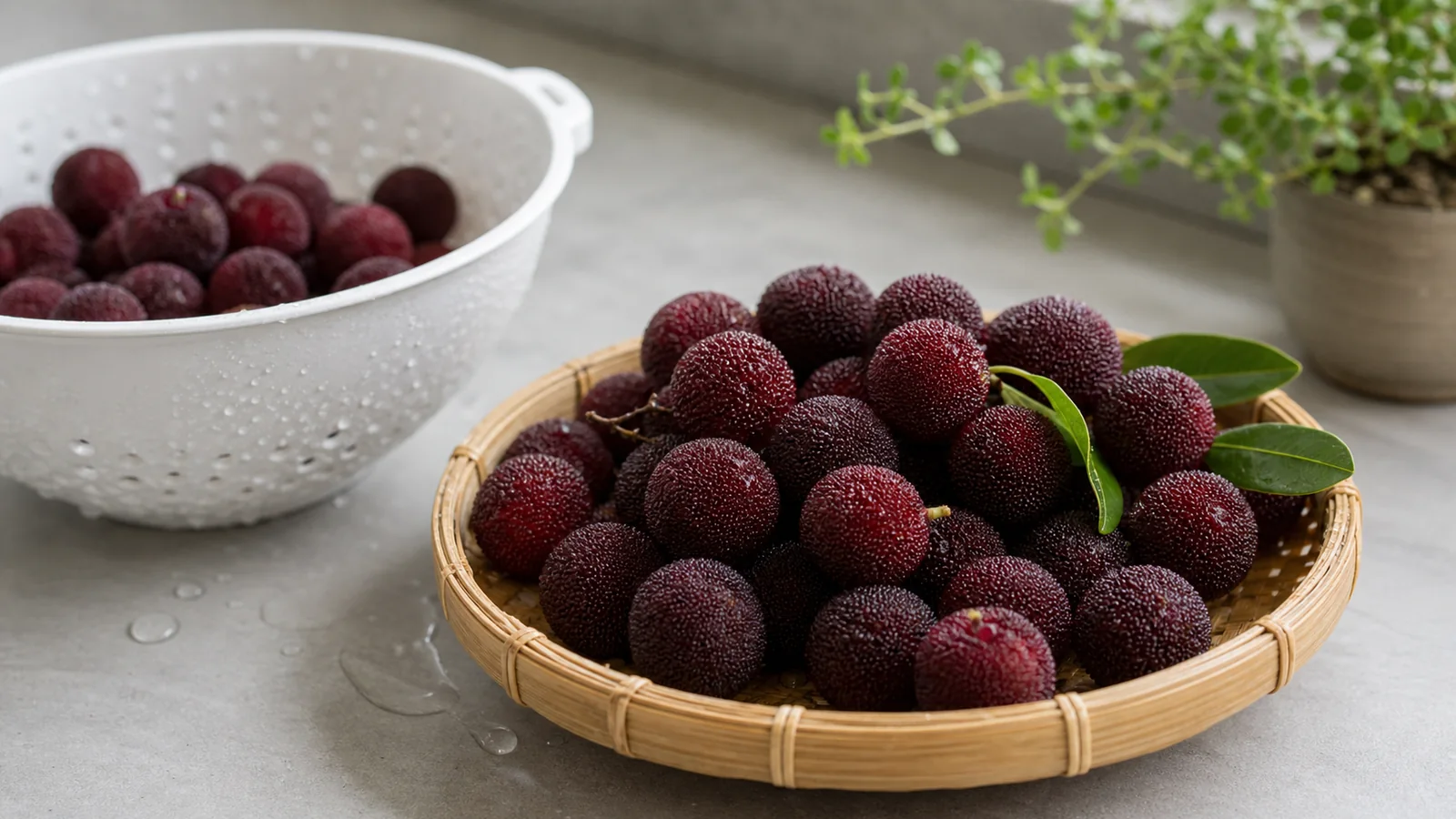
It's yangmei (Chinese bayberry) season again, and when news reports say it contains "carcinogens" or is "tainted," any parent's heart sinks. No need to panic — we've gone through all the reports. Simply put: the "chemicals" mentioned are mostly legal additives that have been misused. As long as you buy from a reputable source and wash thoroughly before eating, yangmei is still a sweet summer fruit you and your kids can enjoy without worry.
What those news stories are saying
Every year around May and June, there are news reports or online rumours about yangmei samples being flagged somewhere. They usually mention a few alarming-sounding chemical names — things like "saccharin," "cyclamate," "sodium dehydroacetate" — and link them to words like "carcinogenic" or "toxic," leaving everyone anxious and unsure whether to eat yangmei at all.
These stories do reflect a real issue: there are cases of inadequate regulation in the market, where some vendors, wanting yangmei to look better, last longer, or taste sweeter, may use additives in violation of the rules. Our job is to understand clearly what these things actually are and learn how to protect our families.
What those chemical names are, and why they show up on yangmei
First, the most important point: most of the substances mentioned in these stories are not "poisons" — they are food additives used in many products. The real issue is not the substances themselves but whether they have been "misused" or "used in violation of regulations" on fresh fruit.1
-
Saccharin / Cyclamate / Neotame: These are artificial sweeteners with very high sweetness intensity. Some yangmei, due to poor weather or incomplete ripening, may not be naturally sweet enough — unscrupulous vendors might soak them in sweetener to improve the taste and make them easier to sell. Under the rules in many places, these sweeteners are permitted in processed foods (such as preserved fruits and drinks) but are generally not allowed on fresh fruit.2
-
Sodium Dehydroacetate: This is a preservative that inhibits mould growth and extends shelf life. Yangmei is a highly perishable fruit that spoils quickly after picking. To facilitate transport and sales, some vendors may illegally apply a preservative to keep the yangmei lasting longer. Similarly, this preservative may be used in certain processed foods but is not permitted on fresh fruit.2
So the core issue here is "illegal misuse," not that yangmei as a fruit is inherently "toxic." The situation is similar to farmers using too many pesticides on vegetables — it is a food-safety regulation problem to be addressed, not a reason to stop eating a particular food altogether.
How it's regulated internationally
Food safety authorities around the world — including Hong Kong's Centre for Food Safety (CFS), China's State Administration for Market Regulation (SAMR), the US Food and Drug Administration (FDA), and the European Food Safety Authority (EFSA) — all have rigorous systems for evaluating and regulating food additives and pesticide residues.345
Based on extensive scientific research, they set Maximum Residue Limits (MRLs) or Acceptable Daily Intakes (ADI). As long as we eat normally — well below those safety standards — there is no health threat.6 The Hong Kong Centre for Food Safety also regularly samples various foods in the market to ensure they comply with local regulations.7 When news reports that a sample failed, that is actually proof that the regulatory system is working — helping filter out problematic products.
What to look for when buying yangmei
Now that we understand the issue, we can be smarter when buying yangmei. China's SAMR has a consumer advisory worth referring to:4
- Look at the colour: choose yangmei that is deep red or purplish-red, with a dry surface and clearly defined individual bumps. Be cautious if the colour looks too vivid red or unnaturally bright. If the water turns strongly coloured when you wash them, or they stain your hands, artificial colouring may be involved.
- Smell them: fresh yangmei should have a light fruity fragrance. If you smell sourness or an alcohol smell, the fruit has started to deteriorate — don't buy it.
- Feel the firmness: gently press one with a fingertip — fresh yangmei should feel firm and springy. If it feels mushy or releases liquid, it's not fresh and will spoil quickly.
- Buy from reputable vendors: whether at a wet market or a supermarket, choose places you trust with a good reputation — their supply is relatively more reliable.
How to prepare yangmei before eating
Once you bring fresh yangmei home, make sure to clean them thoroughly before eating. This step not only removes dust and debris but can also reduce potential pesticide residues and additives.
- Don't put them straight in the fridge: if yangmei are still wet when you bring them home and you put them in the fridge immediately, they'll spoil faster. It's best to spread them out and let them air-dry a little first.
- Soak in salt water: prepare a bowl of clean water with a good pinch of salt and soak the yangmei for 10–20 minutes. Salt water alters the osmotic pressure on the fruit surface, which helps drive out any tiny insects that may be hiding in the crevices (fruit fly larvae — harmless to eat but unappetising).8 You may see small white specks floating on the water surface — that's them.
- Rinse under running water: after the salt-water soak, rinse gently under running water, drain, and they're ready to eat.
- Eat them soon: yangmei is delicate — once washed, it's best to eat it right away. If you really can't finish them, store in a sealed container in the fridge and eat within a day or two.
One line to sum it up
As long as you know how to choose and how to prepare them, yangmei is still a sweet, juicy, and delicious seasonal summer treat. Don't let exaggerated rumours make you miss out on them — enjoy them with your kids!
Sources
-
Taiwan Food and Drug Administration, Department of Health. (n.d.). Food and Drug Administration, Department of Health. Retrieved from https://www.fda.gov.tw/eng/lawContent.aspx?id=304 ↩
-
China State Administration for Market Regulation. (n.d.). National Standard|GB/T 5009.20-2003. Retrieved from http://openstd.samr.gov.cn/bzgk/std/newGbInfo?hcno=A6C6E832EDF95058ADCB410572D9D4AB ↩↩
-
Hong Kong Centre for Food Safety. (n.d.). Pesticide Residues in Food. Retrieved from https://www.cfs.gov.hk/english/consumer_zone/foodsafety_contaminants_pesticide.html ↩
-
China State Administration for Market Regulation. (2025). Consumer advisory on yangmei. Retrieved from https://www.samr.gov.cn/spcjs/yjjl/art/2025/art_f39caa11e71b4d15aaff3e7d3716368f.html ↩↩
-
U.S. Food and Drug Administration. (n.d.). Chemical Contaminants & Pesticides. Retrieved from https://www.fda.gov/food/chemical-contaminants-pesticides ↩
-
European Food Safety Authority. (n.d.). Chemical monitoring. Retrieved from https://www.efsa.europa.eu/en/data-report/chemical-monitoring ↩
-
Hong Kong Centre for Food Safety. (n.d.). Pesticide Residues in Food. Retrieved from https://www.cfs.gov.hk/english/programme/programme_rafs/programme_rafs_fc_02_03.html ↩
-
Macao Consumer Council. (2020). Are the little white worms in yangmei safe to eat?. Retrieved from https://www.consumer.gov.mo/News/Data/PDF/CH/2020/6/06202005165726_%E4%B8%AD%E5%9C%8B%E8%B3%AA%E9%87%8F%E6%96%B0%E8%81%9E%E7%B6%B2_%E6%A5%8A%E6%A2%85%E8%A3%A1%E6%9C%89%E5%B0%8F%E7%99%BD%E8%9F%B2%E5%8F%AF%E4%BB%A5%E5%90%83%E5%97%8E.pdf ↩
Monthly food-safety newsletter
Each month: the most important food-safety news, product recalls, and what Papa actually buys. Free, and your email stays private.