
Consumer Council cooking-oil test: 4 over the limit, 21 five-star — check which oil you use at home
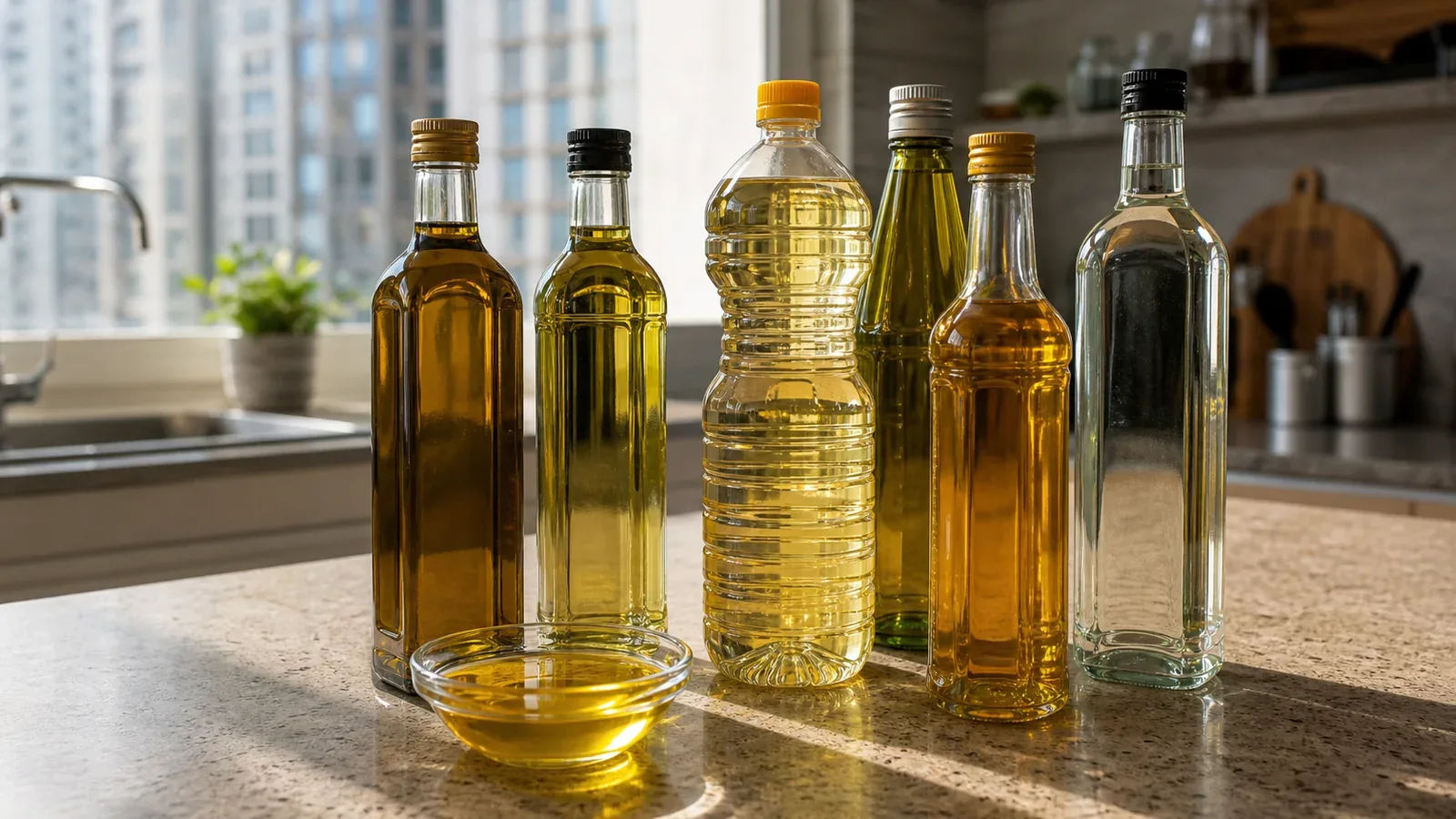
Consumer Council tested 50 cooking oils; 4 had contaminants above EU limits, but health risk at normal consumption is low. Papa's List has compiled the 21 five-star safe choices to help you avoid the problem samples.
What happened
The Hong Kong Consumer Council's Choice magazine, issue 549, July 2022, published test results for 50 common cooking oils on sale in Hong Kong. The test covered 13 categories, including extra virgin olive oil, canola oil, peanut oil, and corn oil. The main items tested were:
- Safety tests: plasticisers, 3-MCPD, glycidyl esters (Glycidol), benzo[a]pyrene, and other contaminants.
- Nutritional tests: saturated fat, unsaturated fat, and trans fat content.
- Smoke-point tests: the temperature at which different oils start to smoke.
Most samples were safe, but 4 samples had contaminant levels exceeding EU limits, and some products showed significant discrepancies between their nutrition labels and actual test results.
Which parents should pay attention
- Families that cook at high heat: if you regularly pan-fry, stir-fry, or deep-fry, pay attention to your oil's smoke point and whether it produces harmful substances at high temperatures.
- Families with young children: children weigh less, so the same amount of a contaminant has a proportionally greater effect on their bodies.
- Parents who trust "cold-pressed" or "extra virgin" claims: the test found 3 samples claiming to be "cold-pressed" or "extra virgin" that contained contaminants normally only produced through high-heat processing — a potential case of misleading labelling.
- Families mindful of fatty acid intake: the fatty acid profiles of different oils vary enormously — coconut oil, for example, is very high in saturated fat, while canola oil is much lower.
What the Consumer Council's report actually says
Samples exceeding limits / in breach of standards
The Consumer Council found 4 samples whose contaminant levels exceeded the Centre for Food Safety action levels or EU upper limits. While the report states that health risks at normal consumption levels are not considered high, if there's a choice, we'd naturally choose the safer option.
| Sample no. | Brand | Product | Origin | Issue | Level found | Standard |
|---|---|---|---|---|---|---|
| #14 | Gallo | My first olive oil Extra Virgin Olive Oil | Portugal | Plasticiser DINP | 11 mg/kg | CFS action level & EU upper limit: 9 mg/kg |
| #21 | SuperFoodLab | Pure Coconut Cooking Oil (Odourless) | Thailand | Carcinogen glycidol (Glycidol) | 1,100 µg/kg | EU upper limit: 1,000 µg/kg |
| #31 | Yu Wan Jia | 100% Pure Corn Oil | China | Harmful contaminant benzo[a]pyrene | 2.1 µg/kg | EU upper limit: 2.0 µg/kg |
| #45 | Yu Pin Huang | Pure Peanut Oil | China | Carcinogen glycidol (Glycidol) | 2,000 µg/kg | EU upper limit: 1,000 µg/kg |
Five-star samples (Papa's recommended safe picks)
The Consumer Council report does not provide a direct "safe list," but we can identify the samples with an overall five-star ★★★★★ rating from the detailed data table for all 50 samples (Table 2). Below is a selection of brands parents are most likely to encounter, which you can buy with confidence:
| Sample no. | Brand | Product | Category | Origin | Approx. price | Smoke point |
|---|---|---|---|---|---|---|
| #1 | Carbonell | Extra Virgin Olive Oil | Extra virgin olive oil | Spain | $55.0 / 500ml | 191°C |
| #2 | TESCO | Extra Virgin Olive Oil | Extra virgin olive oil | UK | $76.9 / 1000ml | 192°C |
| #4 | Filippo Berio | Extra Virgin Olive Oil | Extra virgin olive oil | Italy | $99.9 / 1000ml | 181°C |
| #8 | Bertolli | Extra Virgin Olive Oil | Extra virgin olive oil | Italy | $109.9 / 1000ml | 192°C |
| #9 | Colavita | Extra Virgin Olive Oil (Cold Pressed) | Extra virgin olive oil | Italy | $78.9 / 500ml | 195°C |
| #10 | city'super | Organic Extra Virgin Olive Oil | Extra virgin olive oil | Spain | $68.0 / 500ml | 189°C |
| #17 | La Tourangelle | Avocado Oil | Avocado oil | France | $116.9 / 250ml | 178°C |
| #33 | Showa | Light Canola Oil (Added Vitamin E) | Canola oil | Japan | $72.0 / 1000g | 239°C |
| #36 | Tai Cheong Food | Quality Pure Canola Oil | Canola oil | Hong Kong packaged | $26.9 / 1000ml | 235°C |
| #40 | Crown | Reserve Peanut Oil | Peanut oil | Hong Kong packaged | $112.9 / 3×800ml | 182°C |
| #46 | Costa d'Oro | Vitapiù 5 Oils | Blended oil | Italy packaged | $50.0 / 750ml | 227°C |
| #47 | CAMEL | Peanut Aroma Cooking Oil | Blended oil | Hong Kong | $140.0 / 5000ml | 217°C |
What you can do today
Check whether this affects your household
- Check the bottle: look at the cooking oil in your kitchen and see whether the brand and product name match any of the over-the-limit samples listed above.
- Think about your cooking habits: does your household deep-fry a lot every day? If you're cooking normally, even if you've used one of the over-limit oils, the risk is not considered high.
- No need to panic: the Centre for Food Safety followed up and concluded that all samples, under normal consumption, would not affect health and comply with Hong Kong law.
Things you can do right now
- Check the brand at home: take a photo and compare it against the "over the limit" and "five-star" lists above.
- Store properly: keep your cooking oil in a cool, dry place away from direct sunlight. Once opened, use it up as soon as possible (ideally within 2–3 months).
- Change your cooking method: use steaming, braising, and boiling more often instead of deep-frying to reduce the chance of producing harmful substances.
How to choose next time you shop
- Refer to the five-star list: next time you're at the supermarket, prioritise brands from the five-star list.
- Match the oil to how you cook:
- High-heat cooking (pan-frying, stir-frying, deep-frying): choose oils with a higher smoke point, such as canola oil, peanut oil, corn oil, or soybean oil.
- Dressings, salads, or low-heat cooking: choose extra virgin olive oil or avocado oil — these have distinctive flavours but lower smoke points.
- Buy smaller bottles: unless your household goes through oil very quickly, buying smaller bottles ensures you finish it before it goes off.
Smoke points and cooking methods
When cooking oil is heated to a certain temperature, it starts to smoke — that temperature is the smoke point. If cooking temperature exceeds the smoke point, the oil breaks down and produces harmful substances and fumes. Based on the Consumer Council test and expert recommendations, different cooking methods suit different oils.
| Oil type | Average smoke point | Suitable for |
|---|---|---|
| Soybean oil | 234°C | Pan-frying, stir-frying, deep-frying |
| Corn oil | 231°C | Pan-frying, stir-frying, deep-frying |
| Canola oil | 218°C | Pan-frying, stir-frying, baking |
| Camellia oil | 222°C | Stir-frying, baking |
| Extra virgin olive oil | 189°C | Dressings, salads, low-heat stir-frying |
| Avocado oil | 172°C | Dressings, salads, low-heat stir-frying |
Professor Yiu Chung-ping of the Hong Kong Polytechnic University recommends the following for high-heat cooking: 1. Choose oils that are higher in monounsaturated fatty acids and also have a higher smoke point. 2. If frying oil darkens, smells rancid, or produces stubborn milky-white foam, replace it. 3. Always make sure your oil's smoke point is higher than your cooking temperature.
The standards to go by
Every standard listed here comes with a link to the original text so you can check for yourself. There are two types: statutory product limits (regulatory level — exceeding them is a problem) and consumer safety reference values (dietary guideline level).
- EU Commission Regulation (EU) 2020/1322 · Statutory product limit
Regulates the maximum levels of 3-MCPD and its fatty acid esters in vegetable oils, ranging from 1,250 to 2,500 µg/kg depending on oil type; maximum glycidol content is 1,000 µg/kg. The over-limit findings for SuperFoodLab (#21) and Yu Pin Huang (#45) were assessed against this limit.
Original text: eur-lex.europa.eu/eli/reg/2020/1322/oj/eng - EU Commission Regulation (EU) 2020/1245 · Food contact materials regulation
Regulates the migration limits of plasticisers in food contact materials — e.g., DINP + DIDP combined must not exceed 9 mg/kg in food. This is the regulation used to assess the Gallo (#14) over-limit finding.
Original text: eur-lex.europa.eu/eli/reg/2020/1245/oj/eng - EFSA Scientific Opinion 2018 · Consumer safety reference value
Established a Tolerable Daily Intake (TDI) for 3-MCPD and its fatty acid esters of 2 µg per kg body weight. The daily upper limit for a 60 kg adult is about 120 µg. This is a dietary guideline safety value, not a statutory product limit.
Original text: efsa.europa.eu/en/press/news/180110 - Hong Kong Harmful Substances in Food (Amendment) Regulation 2021 · Local statutory limit
Came into effect 1 June 2023; specifies a benzo[a]pyrene upper limit in cooking oils of 5 µg/kg. Yu Wan Jia (#31) at 2.1 µg/kg complied with Hong Kong's new regulation but already exceeded the EU limit of 2 µg/kg.
Original text: CFS regulation page
Note: The US FDA currently monitors 3-MCPD and glycidol in infant formula (FDA monitoring page), but has not yet set statutory limits for vegetable oils. "Exceeding EU limits" does not mean "FDA-approved" — the two jurisdictions simply have different regulatory priorities.
A few things to keep in mind
- 2022 data: this report is from July 2022; manufacturers may have since updated their formulas.
- The Consumer Council is not an enforcement body: it refers problematic cases to the Centre for Food Safety and Customs for follow-up.
- Five-star does not mean low-fat: the five-star overall rating is based mainly on safety tests and fatty acid ratios, but all oils are high in fat and should be consumed in moderation.
- Storage matters: even a good oil, if stored badly (e.g., next to the hob or in direct sunlight), will deteriorate.
Sources
Every number, every brand name, every recommendation in this article can be traced back to one of the sources below. We do not sell products or take advertising — all conclusions are open for you to verify yourself.
Hong Kong Consumer Council (core test reports)
- Hong Kong Consumer Council, Choice magazine issue 549 (July 2022), "Test of 50 cooking oils finds samples containing carcinogen! Plasticiser and contaminants over the limit!"
- Hong Kong Consumer Council, Safety test results (names the 4 over-limit samples and their actual test values)
- Hong Kong Consumer Council, Smoke-point test results and myths about high-heat cooking (includes average smoke points for 7 oil categories and expert opinion from Professor Yiu Chung-ping)
- Hong Kong Consumer Council, Table 1: EU maximum levels for 3-MCPD and its fatty acid esters (PDF)
- Hong Kong Consumer Council, Table 2: Detailed test results for all 50 cooking oil samples (PDF) (the complete list of 21 five-star samples is drawn from this table)
Original regulations and international safety reference values
- EU Commission Regulation (EU) 2020/1322 — Maximum levels of 3-MCPD and glycidol in vegetable oils: eur-lex.europa.eu/eli/reg/2020/1322/oj/eng
- EU Commission Regulation (EU) 2020/1245 — Plasticiser migration limits for food contact materials: eur-lex.europa.eu/eli/reg/2020/1245/oj/eng
- European Food Safety Authority (EFSA), press release 10 January 2018 — Re-evaluation of the TDI for 3-MCPD (2 µg/kg body weight): efsa.europa.eu/en/press/news/180110
- Hong Kong Centre for Food Safety (Food and Environmental Hygiene Department), Harmful Substances in Food (Amendment) Regulation (effective June 2023; benzo[a]pyrene limit in cooking oils 5 µg/kg)
- US FDA — 3-MCPD and glycidol monitoring page (note: FDA monitors but has not set statutory limits): fda.gov/food/process-contaminants-food/3-mcpd-and-glycidyl-esters
Monthly food-safety newsletter
Each month: the most important food-safety news, product recalls, and what Papa actually buys. Free, and your email stays private.