Why is mercury showing up in dried porcini?
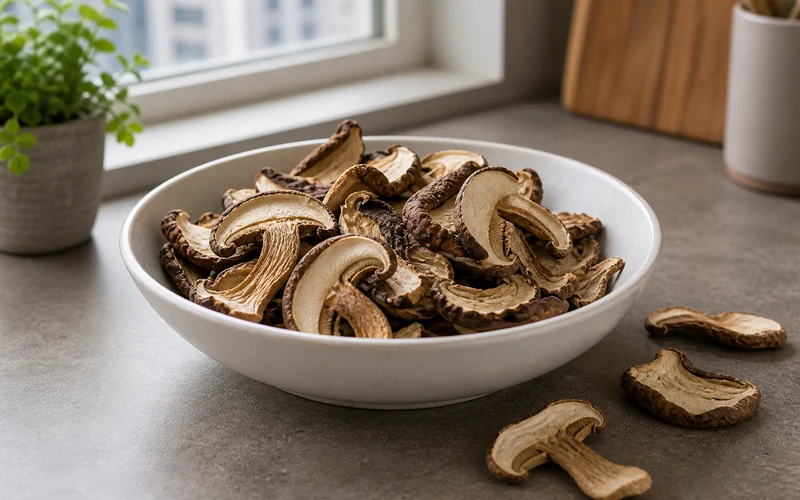
The one-line takeaway for parents
The Centre for Food Safety found that a pre-packaged French dried porcini product from "Hang Hing Hong" had a mercury content of 0.297 mg/kg, exceeding the legal limit of 0.1 mg/kg.1
Mushrooms are natural heavy-metal accumulators by biology. Porcini (Boletus) are among the types most prone to absorbing mercury — this is not new; international research has been documenting it for decades. The Centre for Food Safety says health risk at normal, small portions is low, but if you have this particular batch, don't eat it. Going forward, treat dried porcini as an occasional ingredient rather than an everyday one.
Why do mushrooms absorb mercury in the first place?
Large fungi (the scientific category mushrooms belong to) are well-known biological "heavy-metal accumulators" (bioaccumulators). Their mycelium spreads several to tens of metres through the soil, drawing up trace metals — including mercury, cadmium, and lead — from the soil and atmospheric deposition, concentrating them in the fruiting bodies (the part we eat).2
This is a natural property of mushrooms — it does not mean anyone added anything. But because of this mechanism, mushrooms are more likely to show detectable trace metals than ordinary vegetables.
Why are porcini especially prone to it?
The genus Boletus (which includes porcini) is one of the strongest mercury accumulators among mushrooms. Polish environmental chemist Falandysz and colleagues have conducted years of research on wild European porcini, finding that mercury levels in dried specimens can far exceed those of other commonly eaten mushrooms.3
Two main reasons:
- Large symbiotic network: porcini form "ectomycorrhizal" associations with tree roots, extending their reach through the soil to absorb metals over a much larger area than most independently growing mushrooms.
- Mostly wild-harvested: unlike cultivated mushrooms (button, shimeji), dried porcini sold in the market are mostly foraged from forests. Forest soils accumulate atmospheric mercury deposition over decades (from past industrial emissions, coal burning, and volcanic activity), and wild mushrooms directly reflect those background concentrations.
Why do dried porcini exceed limits more easily?
Fresh mushrooms are about 85–92% water. The drying process drives off that water but leaves the metals behind — so the same raw material will read roughly 10 times higher in a dried product than in fresh weight.4 In other words, the dried sample found at 0.297 mg/kg would be equivalent to roughly 0.03 mg/kg in fresh weight — not an extreme figure proportionally, but because the legal standard is assessed on the product "as sold," the dried product exceeds the limit.
Is it dangerous to have eaten some?
Mercury in mushrooms is mainly inorganic mercury, which is less toxic than the organic methylmercury found in deep-sea fish — but long-term accumulation still affects the kidneys and nervous system, and children and pregnant women should be especially careful.5 The WHO/FAO Joint Expert Committee on Food Additives (JECFA) sets the Provisional Tolerable Weekly Intake (PTWI) at 4 µg per kg body weight.6
The Centre for Food Safety's assessment this time was: at the level detected, health risks from normal, small consumption are low.1 But that conclusion is based on "normal, small" portions — it does not mean you can treat porcini as a dietary staple.
What parents can do
- Check at home: do you have Hang Hing Hong "French dried porcini"? If the batch matches, don't eat it.
- Treat it as an occasional ingredient, not an everyday one: dried porcini add great flavour, but there's no need to eat them daily. A few times a month in soup or pasta is well below JECFA's weekly tolerable intake.
- If you want the flavour and texture of mushrooms, rotate your varieties: shimeji, shiitake, king oyster, button, oyster mushrooms — these cultivated varieties grow on controlled substrates and accumulate far less mercury than wild porcini.
- When buying dried porcini: check origin and batch information; packaging that mentions third-party testing or certified heavy-metal testing gives you an extra layer of assurance.
One line to sum it up
Trace metals in mushrooms are natural — they don't mean the mushrooms are "toxic." Porcini's tendency to accumulate mercury doesn't mean you can't eat them. The key is: know the fact, treat them as an occasional ingredient rather than a staple, look a little more carefully when buying — and you and your kids can still enjoy them without worry.
Sources
-
Hong Kong Centre for Food Safety (Food and Environmental Hygiene Department). (21 May 2026). Pre-packaged dried porcini mushroom sample found to contain metallic impurities exceeding legal standard. https://www.cfs.gov.hk/tc_chi/unsat_samples/20260521_12403.html ↩↩
-
Kalač, P. (2010). Trace element contents in European species of wild growing edible mushrooms: A review. Food Chemistry, 122(1), 2–15. https://doi.org/10.1016/j.foodchem.2010.02.045
-
Falandysz, J., & Borovička, J. (2013). Macro and trace mineral constituents and radionuclides in mushrooms: health benefits and risks. Applied Microbiology and Biotechnology, 97(2), 477–501. https://doi.org/10.1007/s00253-012-4552-8
-
Hong Kong Centre for Food Safety. Metallic Contamination in Food (includes general background concentrations of mercury in food and calculation method for dried food products). https://www.cfs.gov.hk/tc_chi/programme/programme_rafs/programme_rafs_fc_01_05_metallic_contamination.html
-
European Food Safety Authority (EFSA) Panel on Contaminants in the Food Chain. (2012). Scientific Opinion on the risk for public health related to the presence of mercury and methylmercury in food. EFSA Journal, 10(12), 2985. https://www.efsa.europa.eu/en/efsajournal/pub/2985
-
WHO / FAO Joint Expert Committee on Food Additives (JECFA). Methylmercury / Inorganic mercury — Provisional Tolerable Weekly Intake. https://www.who.int/news-room/fact-sheets/detail/mercury-and-health
Monthly food-safety newsletter
Each month: the most important food-safety news, product recalls, and what Papa actually buys. Free, and your email stays private.